Design for
Value Creation
Over the past two decades, the role of design in companies has changed fundamentally. While design was traditionally associated with the form, aesthetics and usability of products, today it increasingly operates within complex systems of hardware, software, services and digital infrastructures. Designers are no longer concerned solely with the manifestation of a product or service but increasingly with the conditions under which it is conceived, developed, experienced and continuously improved.
As a consequence, design has become closely connected to questions of innovation, organizational transformation and corporate strategy. Yet there remains a remarkable discrepancy between this expanded role and the way design is positioned within many organizations. Its operational contribution is widely recognized, while its strategic and economic potential often remains underestimated.
The most established contribution of design is still differentiation. Good design makes products and services easier to use, aesthetically distinctive and more coherent in their interaction with customers. It strengthens brands, improves customer experience and can create competitive advantages in markets where technological performance alone is increasingly insufficient to distinguish one offering from another. As technological innovations become more rapidly available across competitors, the quality of the overall experience becomes an increasingly important factor in purchasing decisions, customer loyalty and willingness to pay a premium.
However, reducing design to differentiation describes only a fraction of its economic potential. One of the most valuable resources within a design organization is its accumulated knowledge about customers and their changing expectations. Designers systematically observe behaviour, identify explicit and latent needs and translate findings from user research, market analysis and social or cultural developments into propositions for future products and services. This knowledge represents a form of business intelligence that is frequently available within organizations but rarely treated as such. Its value lies not merely in improving existing offerings, but in identifying emerging market opportunities and informing decisions about new products, services and business models.
This capability becomes particularly important in innovation processes. Technological development produces possibilities, but technological novelty alone does not create market value. Value emerges when new technological capabilities can be translated into applications that are meaningful to people and economically relevant to organizations. Design operates precisely at this intersection. Through research, prototyping, testing and iterative development, it also provides mechanisms for examining assumptions before substantial resources are committed to implementation. From this perspective, design is not only a means of creating innovation but also a means of reducing the economic risks associated with it.
»Design is shifting its value from products to organizational capabilities.«
The relevance of this proposition becomes apparent when considering how fundamentally the object of design has changed. Many contemporary products can no longer be understood as discrete objects. A vehicle, medical device, domestic appliance or industrial machine may simultaneously be a physical product, a software platform, an interface, a service and part of a larger digital ecosystem. Customers encounter these elements as one coherent experience, regardless of how responsibilities are distributed within the company.
Organizations, however, are usually structured according to functions and disciplines. Hardware, software, service, marketing, sales and customer support may operate within different divisions, budgets and management structures. These organizational boundaries are invisible to customers but become highly visible whenever the resulting experience fails to work as a whole. The quality of a contemporary product is therefore determined not only by the quality of its individual components but increasingly by the relationships between them.
Design consequently has to operate across organizational boundaries. User experience and brand experience can no longer be considered independently, just as physical, digital and service design can no longer be organized as entirely separate activities. Design systems, common quality standards, user research and appropriate governance structures become instruments for creating coherence across increasingly complex ecosystems.
Many companies have responded by building highly professional internal design organizations. Particularly during the past decade, corporations have invested substantially in UX, research, design systems and specialized design teams. At the same time, design methods have spread far beyond the boundaries of these departments. User research, customer journey mapping, usability testing, prototyping and iterative development have become established practices in product management, innovation, strategy and organizational development.
This diffusion creates a paradox. The more deeply design practices become embedded in organizations, the less likely they are to be recognized as design. Designers facilitate interdisciplinary teams, create a shared understanding of customers, visualize strategies and introduce iterative ways of working into organizations traditionally built around linear processes. Their methods can change how organizations understand problems, collaborate and respond to uncertainty. Yet these contributions are often not reflected in formal responsibilities, budgets or governance.
Companies therefore benefit from design capabilities without necessarily acknowledging or managing them as such. Designers may contribute substantially to organizational transformation while lacking an explicit mandate to transform the organization. A more mature understanding of design requires greater clarity about these different forms of value creation and about the authority, resources and responsibilities required to deliver them.
»Designers are allowed to improve the answer, but rarely to define the question.«
This describes one of the central limitations of design in many organizations. Design tends to be strongest where its contribution is most visible and weakest where decisions become most strategic. Companies have become highly sophisticated in managing design quality and consistency, while designers remain comparatively underrepresented in management positions. They may have substantial responsibility for the customer experience but limited influence on the decisions concerning technologies, portfolios, business models or product specifications that ultimately determine it.
The transition from Design Management to Design Leadership must be understood against this background. Design Management organizes design activities, resources and processes and ensures the quality of their outcomes. Design Leadership extends this responsibility by connecting design capabilities to the future direction of the organization. It translates changes in society, technology and customer behaviour into opportunities, uses customer knowledge to inform strategic decisions and maintains the coherence of customer experience across organizational boundaries.
Such responsibilities cannot be exercised effectively without corresponding authority. If design is expected to orchestrate an ecosystem, it requires governance across that ecosystem. If it is expected to contribute to transformation, it requires an appropriate mandate. And if design is expected to contribute to corporate strategy, designers need to be represented where strategic decisions are made.
Greater influence also requires greater accountability. Design cannot claim strategic relevance while remaining imprecise about its contribution to economic performance. Design organizations need to understand and communicate how their work affects customer loyalty, differentiation, innovation, development risk and market opportunities. Not every contribution can or should be reduced to a financial indicator, but its impact must be articulated in a language relevant to corporate decision-making.
This also requires designers to broaden their own professional competence. Expertise in users and creative methods remains essential, but strategic responsibility demands technological literacy, an understanding of business models and markets, and the ability to navigate complex organizations. The central question is therefore no longer whether design can create better products. The more relevant question is how design can contribute to creating better companies: organizations that understand their customers more deeply, recognize opportunities earlier, integrate technological change more meaningfully and develop innovations with lower risk and greater relevance.
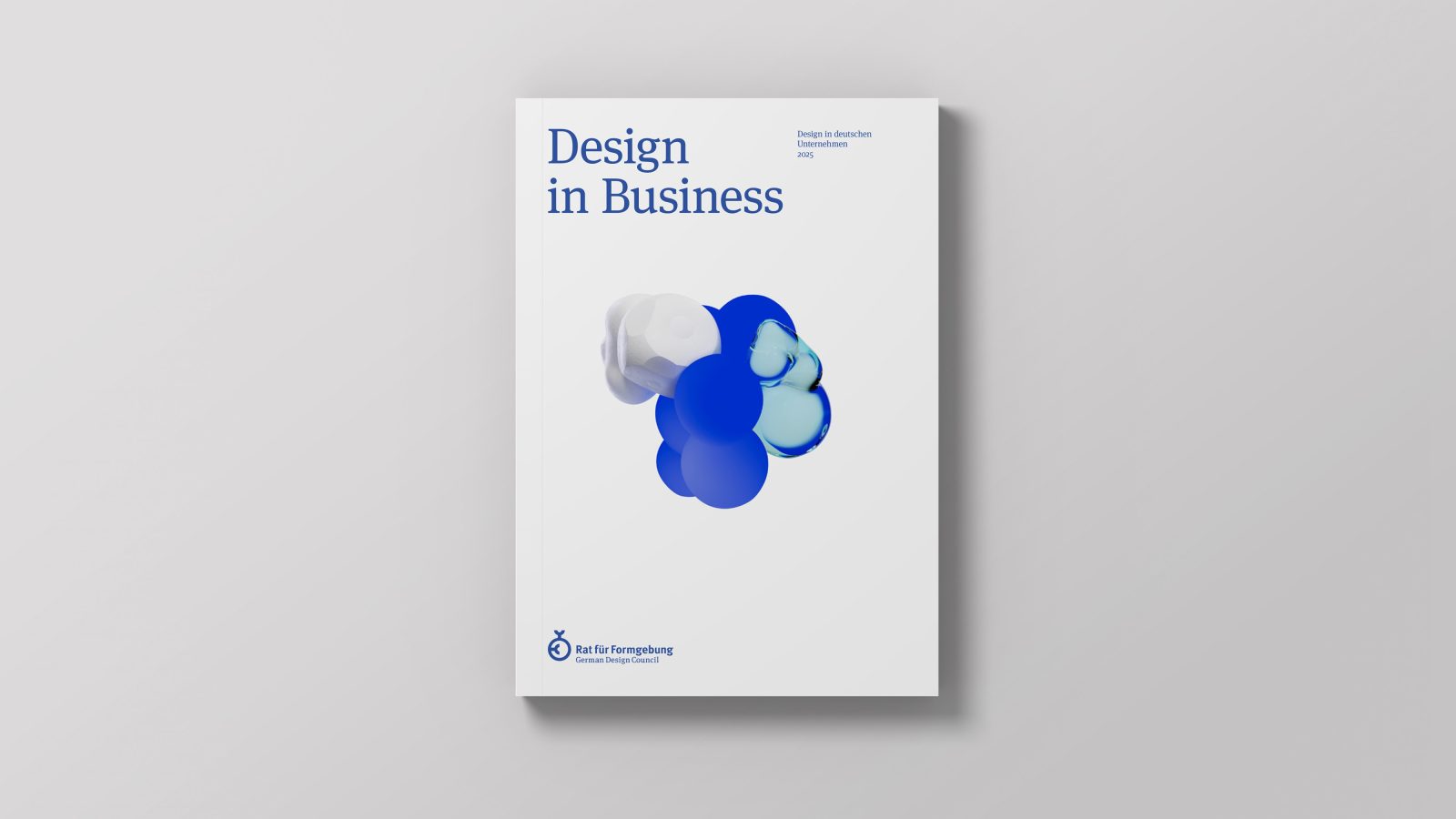
Design for Value Creation ultimately describes a shift from designing the outputs of an organization to contributing to the design of the organization itself. Realizing this potential requires clearer mandates, differentiated governance, appropriate budgets, the integration of physical, digital and service design and a stronger representation of designers in management. Most importantly, it requires senior leadership to understand design not as a service that improves decisions once they have been made, but as a capability that contributes to making better decisions in the first place.
Philipp Thesen, 2025. Based on a speech presenting the Design in Business study at the German Design Awards, Frankfurt a.M., January 2025.